How many moose are in Bighorn National Forest?
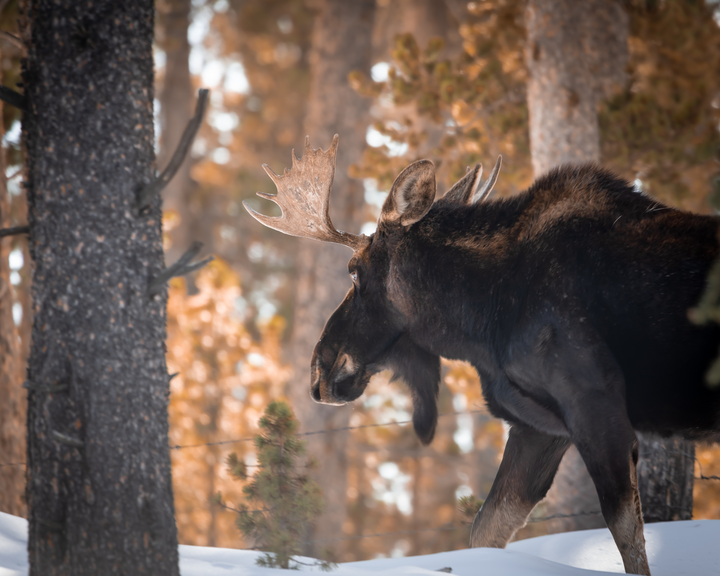 A bull moose roams Bighorn National Forest. (Photo: Jeff Wagner)
That’s a good question. How do you even begin to count all of the animals in a population, especially when they live in densely forested areas? The short answer is — you don’t. But how then are wildlife managers supposed to monitor and manage those populations? This is one of the great questions of our time. Knowledge of animal abundance (how many animals exist in a population) and animal density (how many animals exist per unit area) is fundamental to understanding their ecology, but gathering such information is no easy feat. In reality, it is usually impossible to know exactly how many animals are on the landscape; however, numerous methods exist to obtain estimates of population sizes, usually by employing statistical models. Some methods are more robust than others, but with great robustness comes great responsibility complexity. This is the focus of my first dissertation chapter: develop methods to obtain a robust population estimate of a patchily distributed species, Shiras moose (Alces alces shiras), in Bighorn National Forest, Wyoming.
Many large herbivore populations in the Western U.S. are monitored via annual aerial surveys, during which a pilot and an observer (often these are the same person) obtain a minimum count of animals they saw during the flight. While minimum population counts can certainly be useful, they lack any measure of uncertainty and by definition underestimate the number of animals in a population. Moose in particular are typically associated with forests and riparian shrublands, the former of which are not conducive to aerial survey methods. Trees are very effective at “hiding” moose from these surveys, further contributing to their underrepresentation of real population sizes. Therefore, we must account for our inability to see every moose during our surveys to get more realistic estimates of population size.

Methods to account for this “imperfect detection” range from simple correction factors to complex models of detection probability, as do the methods for counting animals. Count methods sometimes rely on direct animal observation (as in aerial surveys), however, all animals — large and small — leave traces of their presence as they traverse the landscape. The prevalence of these traces is fundamentally related to the number of animals that left them, and I am particularly interested in leveraging the information in these clues to estimate wildlife population sizes. I am applying this concept to estimate the population size of moose using only information animals left behind: tracks, scat, and hair left in the snow that I collected at hundreds of sites throughout Bighorn National Forest.

I will use the DNA found in scat and hair samples to identify individual moose and estimate their population size with a Spatial Capture-Recapture (SCR) model. Because all moose leave tracks in the snow, these too are useful indicators of abundance. Indeed, moose tracks are a telltale sign of where moose have been. Thus, by focusing genetic sampling in areas where tracks are present, we can obtain the maximum amount of samples (data) in the least amount of time. This approach is called Adaptive Sampling, a highly efficient approach by which observers are constantly adapting to changing field conditions to focus on areas with obvious signs of animal activity. There exists some relationship between the number of moose paths in the snow, the amount of scat and hair present in that area, and the number of moose that live there. I intend to integrate this wealth of information into an Adaptive SCR model to obtain a robust population estimate of moose in the Bighorn Herd.


Jeff Wagner
PhD Student, Quantitative Ecologist
My research interests include developing novel approaches to bridge the gap between applied boots-on-the-ground field studies, advanced quantitative computing technologies, and ecological statistics.