Understanding Patterns of Collared Pika Density in Rapidly Changing Alpine Ecosystems of Alaska
Abstract
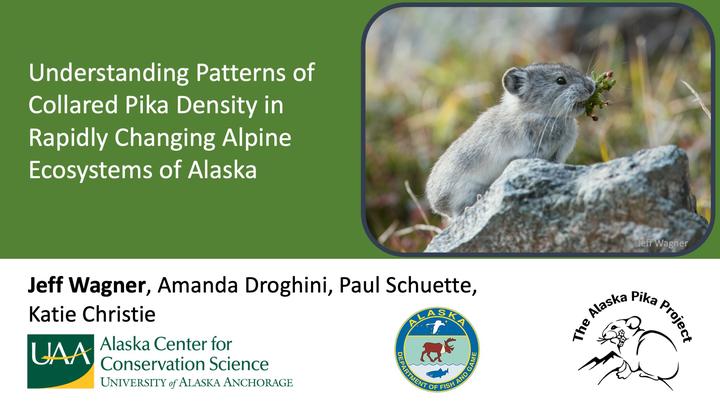
The collared pika (Ochotona collaris) is known to inhabit alpine talus and boulder fields across northwestern Canada and Alaska and is considered to be an important indicator species for the health of alpine ecosystems. Alpine ecosystems in Alaska are undergoing rapid changes including the expansion of shrubs and warmer winter temperatures. Information on the status of pika populations in Alaska is currently lacking and the impacts of climate change on survival and abundance are currently unknown. In the summers of 2018-2019, the Alaska Center for Conservation Science (ACCS) surveyed sites across the state in an effort to understand patterns in pika occupancy and abundance across space and time. This research is part of a joint research project with the Alaska Department of Fish and Game (ADF&G) and the University of Idaho (UI), who are investigating the demography and foraging ecology of pika in Alaska. The current study uses spatially-explicit distance sampling data to estimate site-level pika density for each location surveyed. Our top model identified several potentially key environmental covariates, including latitude, ordinal day, average wind speed and local vegetative cover, which may be important drivers of pika density. Collectively, this information and that obtained over the course of the total research effort will enhance our knowledge of how pika occupancy, abundance, survival, and diet are influenced by environmental change in Alaska.
Slides can be added in a few ways:
- Create slides using Wowchemy’s Slides feature and link using
slidesparameter in the front matter of the talk file - Upload an existing slide deck to
static/and link usingurl_slidesparameter in the front matter of the talk file - Embed your slides (e.g. Google Slides) or presentation video on this page using shortcodes.
Further event details, including page elements such as image galleries, can be added to the body of this page.
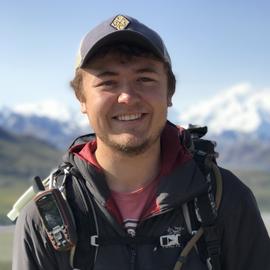
Jeff Wagner
PhD Student, Quantitative Ecologist
My research interests include developing novel approaches to bridge the gap between applied boots-on-the-ground field studies, advanced quantitative computing technologies, and ecological statistics.